


U.S. Tax System for Foreigners and/or Expatriates

What Most People Don’t Understand and Why It Is So Important
The U.S. tax system can become especially complex when business activities, investments, and international mobility are involved. Whether you were born outside the country, recently moved to the USA for work, or now live abroad but maintain operations in the United States, the rules do not always work the way many people assume.
Many mistakes occur because people believe their tax obligation depends solely on where they live or their nationality. However, the U.S. tax system is based on technical criteria such as tax residency, source of income, and the obligation to report worldwide income. Understanding these concepts from the ground up is essential to avoid costly errors and IRS penalties.
Tax Residency Not the Same as Immigration Status
One of the most confusing topics is tax residency. For the IRS, tax residency does not depend solely on visa type or immigration status. The determination is primarily based on the amount of time physically spent in the United States, whether the individual is a U.S. citizen, holds a Green Card (lawful permanent resident), or meets the substantial presence criteria established by law.
In other words, the IRS considers how much time you spend in the country, whether you are a citizen, whether you are a Green Card holder, and your level of physical presence in U.S. territory to determine whether you are classified as a tax resident.
The Substantial Presence Test establishes that if a person was present at least 31 days during the current year and, when combining the days of the current year, one-third of the previous year, and one-sixth of the year before that, reaches 183 days, they may be considered a tax resident.
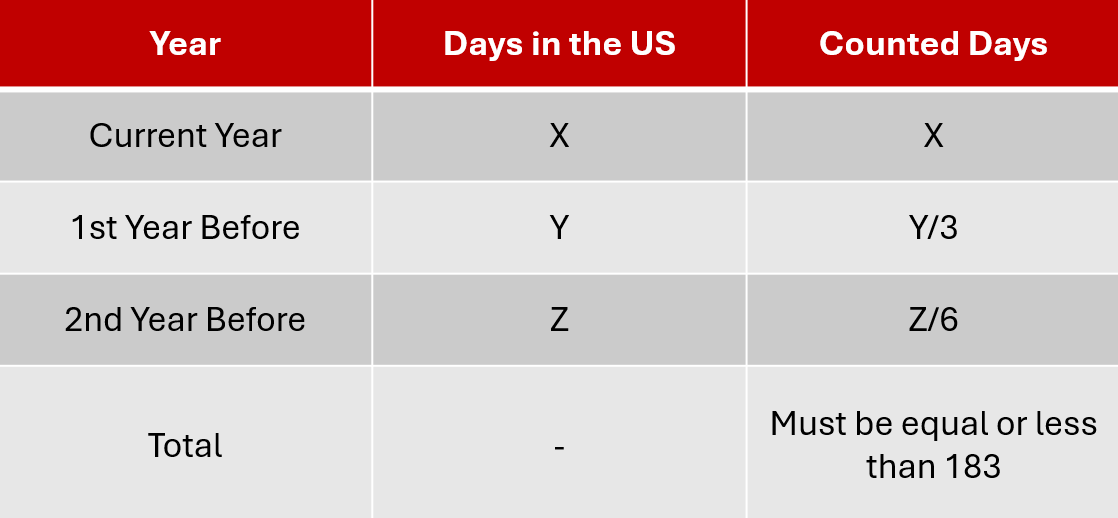
Additionally, Green Card holders are generally considered tax residents automatically, even if they spend long periods outside the country. This means they must report worldwide income, income generated both inside and outside the U.S.
Tax residency determines the scope of taxation: some individuals are taxed only on U.S.-source income, while others are subject to the U.S. tax system on all their income, regardless of the country where it originates.
Your Taxes Depend on the Source of Your Income
Another essential aspect of the U.S. tax system is the source of income.
Income from rental properties located in the U.S., businesses operating within the country, or services physically performed in U.S. territory is considered U.S.-source income. This applies even when the taxpayer lives outside the country or does not have tax residency, filing as a Nonresident Alien. (It is important to consider tax treaties between countries.)
On the other hand, when tax residency exists, the obligation expands to worldwide income. This means that salaries, investments, or rental income generated abroad must also be reported under the U.S. tax system.
This combination of rules explains why foreign owners, individuals who move out of the United States, or professionals who come to the country for work may face unexpected tax obligations.
Expatriates Within the U.S. Tax System
U.S. Expatriate Living Abroad
This group includes U.S. citizens and permanent residents with a Green Card who move outside the United States.
One of the most common mistakes is assuming that living in another country automatically eliminates their obligations with the IRS. However, the U.S. tax system continues to apply regardless of where they reside.
If you maintain tax residency, you must report your worldwide income, even when your salary, business, or investments are generated entirely abroad. This means that an expatriate living in Europe, Latin America, or Asia is still required to file a U.S. tax return, even if they also pay taxes in their country of residence.
There are mechanisms such as the Foreign Earned Income Exclusion (FEIE) and foreign tax credits designed to reduce the risk of double taxation. However, these mechanisms do not eliminate the obligation to file or any additional informational reporting requirements that may apply.
Additionally, maintaining a Green Card or meeting the substantial presence criteria can keep your tax residency active, even when spending long periods outside the country.
Foreign Expatriate Who Comes to Work in the U.S.
The second profile is a foreign national who moves to the United States to work, generally sponsored by a U.S. company.
In many cases, these individuals assume their employer fully handles their taxes or are unaware of how the U.S. tax system works. However, their immigration status, length of stay in the country, and substantial presence criteria may classify them as Tax Residents or keep them as Nonresident Aliens with specific obligations.
Depending on their classification, they may be subject to:
Federal and state taxes
Mandatory withholdings
Additional informational filings
Possible benefits under tax treaties
At Jambrina CPA, we are CPAs specialized in international taxation and expatriate planning, offering advisory services in Spanish and English for individuals who live and work between two countries.
International Tax Treaties Can Make the Difference
The United States maintains tax treaties with several countries, and these may provide important benefits depending on your nationality and tax status. However, their application is neither automatic nor universal. Each treaty establishes specific rules depending on the type of income and the relationship between both countries.
Properly applying a treaty requires analysis and documentation. An error in interpretation or reporting may invalidate the benefit and result in IRS adjustments. In international scenarios, having the support of Jambrina CPA allows you to apply these agreements confidently, avoid unnecessary risks, and protect your tax benefits from the beginning.

Why Working With Us Is Your Best Option
The U.S. tax system, especially in international scenarios, requires technical knowledge and practical experience. Having a CPA near you who understands both the local and international context can make a significant difference.
At Jambrina CPA, we work with foreign business owners and workers, investors, and expatriates seeking clarity, compliance, and strategic tax planning. As experienced CPAs in Texas and throughout the United States, we provide tax advisory services in Spanish and English, helping our clients understand their obligations and make informed decisions before problems arise with a reliable CPA always ready to help.